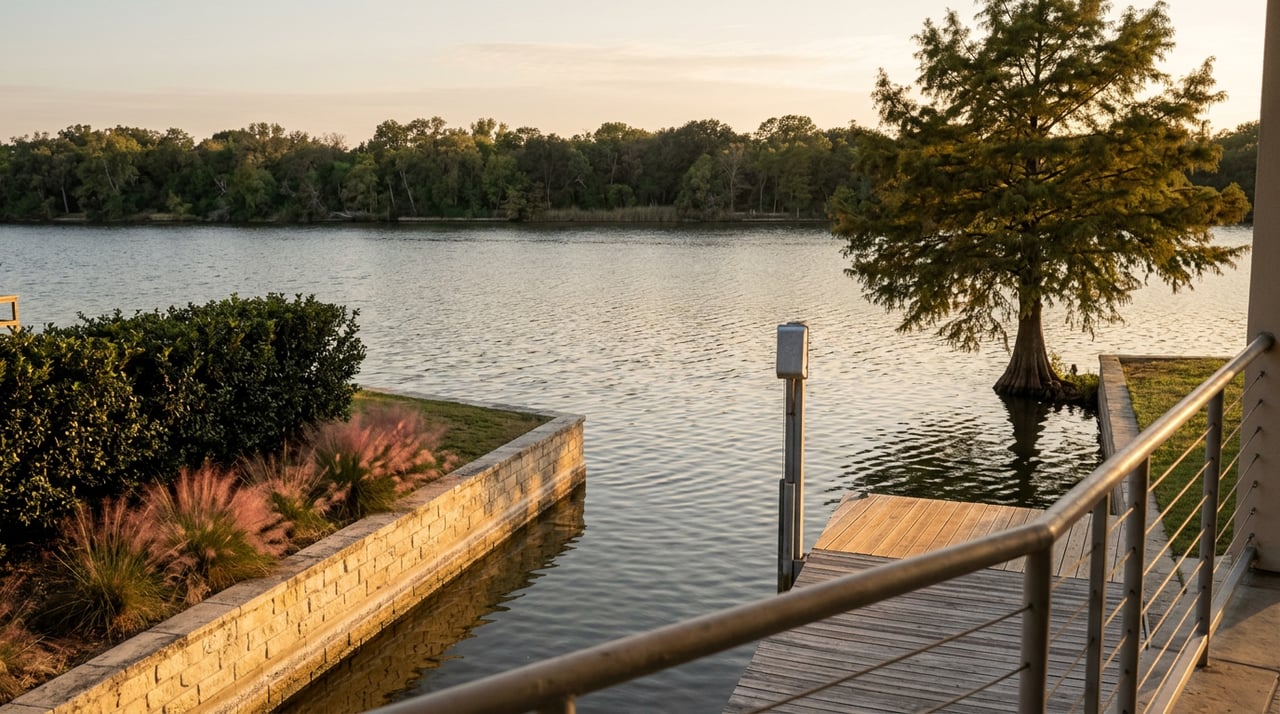
"No residence, building and/or outside appliance will be constructed closer than twenty-five (25) feet to the edge of water in Lake LBJ when filled to its normal water level of 825 feet above sea level."
That's the entire rule, straight from Highland Haven's zoning code. It reads like the kind of number you can build around with a tape measure and a Saturday afternoon. On most waterfront lots in the city, it is exactly that simple.
On lots with an inland boat slip, cut into the shoreline off a canal, the setback measurement has a practical wrinkle: the cut changes the shoreline within the lot. If you own, are buying, or are about to build on one of these lots, the outcome will move the line your addition, garage, or new waterfront facility gets measured against.
The Baseline Rule Is More Layered Than "25 Feet"
Highland Haven's code treats any dock, seawall, bulkhead, or boat ramp as major waterfront construction, not a minor add-on. That classification triggers permit review and a certified survey before the city will sign off, as required by the Highland Haven code. For waterfront facilities on a canal, cove, or open water, approval runs through a three-member panel under the Highland Haven code, made up of the city's building permit official, one elected official, and one planning and zoning commissioner. That panel reviews the application and passes a recommendation to the permit official, who issues or denies it.
Layered on top of the 25-foot lake setback is a 5-foot side setback that also applies to waterfront construction, plus a navigational-clearance rule for canals: a minimum 35-foot clear channel must be preserved from any existing waterfront structure on the opposing shore, and on canals wider than 35 feet, a new structure still can't extend past a line 17.5 feet from the centerline. None of this is unique to Highland Haven's waterfront facilities alone. The state's Lower Colorado River Authority sets its own baseline safety standards for every residential dock on Lake LBJ, covering flotation, lighting, anchoring, and how far a structure can reach from shore. Highland Haven's rules sit on top of that baseline.
None of that is in dispute. What has been in dispute, at least in practice, is where you start counting the 25 feet on a lot where the shoreline itself has been reshaped.
What Cutting a Slip Actually Does to the Setback Line
An inland boat slip is a channel cut into a lot off the main canal, giving a homeowner covered or semi-private mooring instead of a straight seawall tie-up. It is a popular improvement on Highland Haven's canal lots, and it has an effect nobody built into the original ordinance language: once you cut a slip, you have created new "edge of water" on your own property, and the city has historically measured the 25-foot setback from the interior edge of that cut rather than from the navigable channel out front, as the May 14 city packet records.
That has a real consequence for the buildable part of the lot. If two neighboring lots have identical square footage and identical canal frontage, but one owner cut a boat slip thirty feet into the property and the other kept a straight seawall, the slip-lot owner has effectively moved their own setback line closer to the house pad, shrinking the area available for an addition, a garage, or a replacement waterfront facility. A deeper cut moves the setback line closer to the house pad, reducing the buildable envelope.
This is the detail that gets missed by anyone comparing two Highland Haven waterfront listings on square footage and frontage alone. The number on the plat doesn't tell you where the private cut has already redrawn the line.
What's Been Moving Through City Hall This Year
The setback measurement question has been on Highland Haven's Planning and Zoning Commission agenda since at least February 2026, according to the February 12, 2026 minutes, and it resurfaced again at the Commission's April 9 meeting. By the time the Commission took it up again on May 14, 2026, staff and the city attorney had put a specific fix in front of the group: measure the 25-foot setback from the navigable channel of Lake LBJ, not from the interior edge of a private slip cut.
The city attorney's guidance, laid out in that May 14 packet, was that measuring from the navigable channel is legally defensible and avoids the ambiguity created when private alterations to a lot effectively move the point the setback counts from. The packet itself frames the discussion as an effort to confirm general direction and provide clarity prior to finalizing ordinance language, which is about as clear a signal as you get that the change was still a recommendation, not a rule, as of that meeting. The clarification does not touch the 25-foot number itself. It changes where the measurement starts.
If you're evaluating a slip-cut lot right now, the honest answer is that the rule you're building against today may not be the rule you're building against by the time your permit is reviewed.
Why This Matters Before You Sign Anything
A shift from measuring at the slip cut to measuring at the navigable channel would, in most cases, push the setback line back toward the water and open up buildable area on slip-cut lots that had been artificially constrained by their own mooring cut. That sounds like good news for owners of those lots, and it likely is, but it changes three things worth confirming before you rely on the old assumption:
- The buildable footprint on a slip-cut lot may be larger than a prior survey or prior denial suggested, which matters if you're planning an addition, a garage, or a waterfront facility replacement.
- A seller representing a slip-cut lot's development potential should confirm the city's current, adopted position rather than citing the historical practice, since the two may no longer match.
- A buyer under contract on a slip-cut lot with plans to build should budget permit-review time for the three-member waterfront panel process, and should ask directly whether the city has finalized the channel-measurement standard or is still applying the older interior-cut practice.
None of this replaces a conversation with Highland Haven's building permit official. It does mean you should have that conversation before you assume anything about what a slip-cut lot will let you build, not after.
A Few Questions Worth Asking Directly
Does this change the 25-foot number? No. The distance stays the same. What may change is the point on the lot the city measures that distance from.
Does this affect straight seawall lots without a cut slip? Not in any way described in the current city record. The ambiguity is specific to lots where a private slip has created interior water.
Who confirms the current, adopted rule? Highland Haven's part-time Building Permit Official, reachable through Highland Haven City Hall, is the point of contact for confirming whether the clarification has been adopted and how it applies to a specific lot.
Does LCRA's approval mean the city will also approve? No. LCRA's residential dock standards and Highland Haven's local ordinance are separate layers, and a structure can meet LCRA's safety standards while still needing to satisfy the city's setback, survey, and panel review requirements.
The Practical Read for Highland Haven Waterfront
A setback that reads as a fixed number on paper has, in practice, been shaped by private choices about where to cut a slip. The direction on the table favors owners of slip-cut lots by anchoring the line to the public channel instead of a private excavation. The safest move for anyone buying, selling, or building on one of these lots is to treat the buildable envelope as a question to confirm with the city, not a number to assume from an old survey.
If you're weighing a Highland Haven waterfront lot, whether it has a cut slip or a straight seawall, Lake LBJ Partners spends its time in these details because they're the ones that decide what you can actually build, not just what you can picture. You can also start with our Highland Haven neighborhood guide for a broader look at the community, or reach out directly if you want a straight answer on a specific lot before you write an offer or list one.
This article is general information, not legal, tax or financial advice. Consult a qualified professional about your situation.
