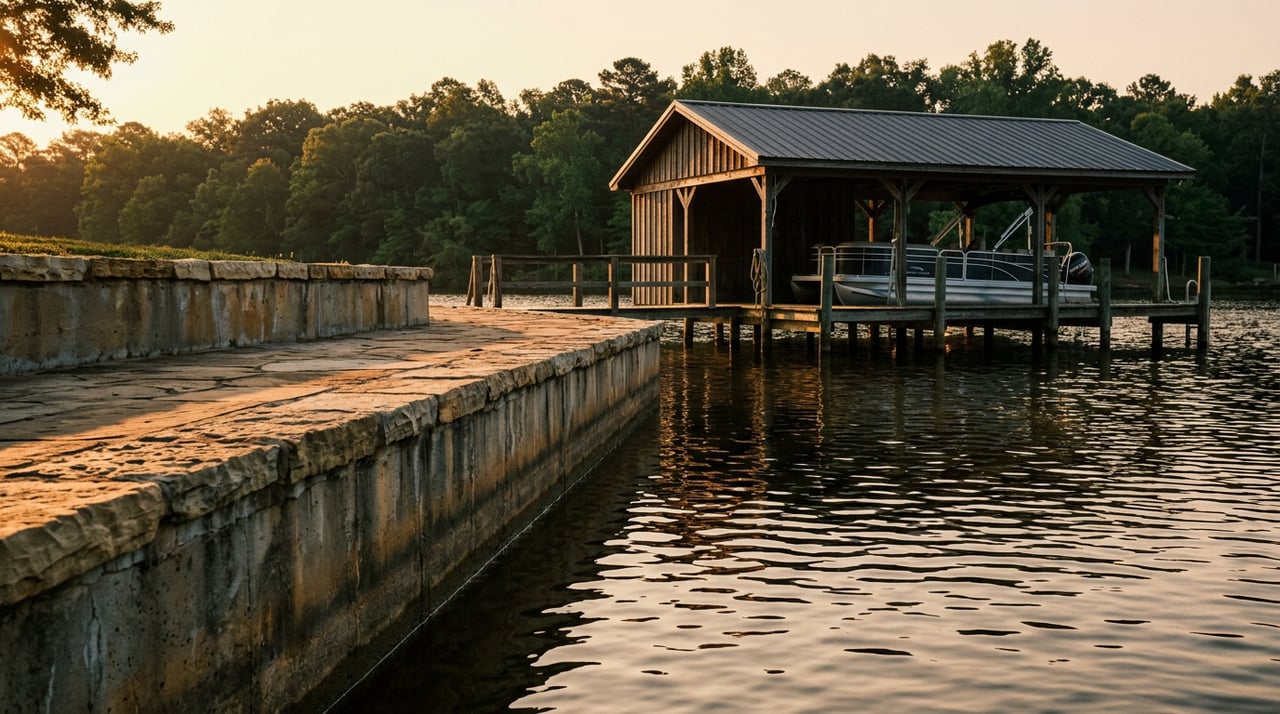
Late in August 2026, the Texas Department of Transportation reopened the low-water crossing everyone in Kingsland calls the Slab, ahead of the August 31 target crews had set for themselves after a round of flash flooding tore through the Highland Lakes in July. It was the third time in less than a decade that stretch of the Llano River had closed the crossing and left docks and boats downstream with a bill. The same road flooded in October 2018. It flooded again over the Fourth of July weekend in 2025, when Lauren Concrete and Aaron Concrete Contractors poured roughly 80 cubic yards of concrete to patch RM 3404 back together. Neighbors interviewed during that 2025 flood said the water hadn't been that high since 2018. Then it happened again in July 2026.
That pattern isn't bad luck. It's geography, and it's the single fact that most out-of-area buyers miss when they start shopping Kingsland waterfront: this town sits at the point where the Llano River empties into the Colorado-fed water of Lake LBJ, and that confluence splits the shoreline into two conditions that behave nothing alike. A lot on the river-mouth side and a lot on the open lake-channel side can look identical in a listing photo and carry completely different risk, completely different bulkhead math, and completely different questions you should be asking before you sign anything.
Two Shorelines, One Zip Code
The river-mouth side of Kingsland deals with current. The Llano River runs clear off granite and gravel substrate, and where it meets the lake, that moving water grinds against the bank year-round, then spikes hard during flood events. The lake-channel side deals with something different: the recreational boat traffic that treats Lake LBJ's channel near Kingsland as its main thoroughfare, which means wake, not current, does most of the erosion work on a calm day.
Those are two different engineering problems wearing the same "waterfront" label on an MLS sheet. A bulkhead built to shrug off boat wake on a protected cove isn't necessarily the right structure to hold back a bank that took a direct hit during the July 2025 or July 2026 flood events. National Weather Service bulletins tied to that July 2026 flood spelled out the stakes at the Llano River's two flood thresholds: near the river's crest of 20.9 feet, major flood stage, forecasters said the flow would be damaging to docks and boats downstream in Kingsland, and as the water receded toward 12 feet, still moderate stage, the follow-up warning told residents to move equipment off low docks and loosen boat ties in that same stretch. That's not a hypothetical bulletin. That's the river doing, on a predictable schedule, exactly what river-mouth shoreline is built to withstand or fail against.
What the Difference Actually Costs
Bulkhead materials aren't priced the same, and the right material depends on which side of the confluence your lot sits on. Rough per-linear-foot starting costs run like this:
| Material | Starting cost per linear foot | Best suited for |
|---|---|---|
| Wood (pressure-treated) | $150 | Sheltered coves, lower wave exposure |
| Stone or boulder | $150 | Rocky Hill Country banks, permeable protection against current |
| Vinyl | $200 | Fluctuating water levels, low-maintenance residential sites |
| Gabion | $200 | Moderate erosion where a rigid wall isn't ideal |
| Concrete (reinforced) | $300 | Tall banks, high soil pressure, high-load or high-traffic sites |
Vinyl gets recommended most often for residential Lake LBJ shoreline because it handles water-level fluctuation without the upkeep wood demands. But that recommendation assumes wake-driven erosion on the calmer lake-channel side. On a river-mouth lot facing current and granite substrate, a stone or reinforced concrete wall is often the more defensible choice, and choosing vinyl there because it worked for a neighbor two coves over on the open lake is the kind of mismatch that shows up as tie-rod failure and washed-out soil the next time the Llano runs high.
A failing bulkhead is also more than a repair line item. It's a flag lenders and insurers look for on waterfront properties, and it hands a buyer real negotiating leverage during option period. Bulkheads carry a rough planning benchmark of about 25 years of service life depending on material and site conditions, floating dock systems run 25 to 30 years, and fixed dock systems can last 40 to 50 years. Age alone doesn't tell the whole story, but it's the first number worth asking about on any Kingsland waterfront listing.
Permits Follow You to Closing, Not Just to the Shoreline
The Lower Colorado River Authority governs docks and shoreline structures on Lake LBJ regardless of which side of Kingsland's confluence a property sits on. Residential docks of 1,500 square feet or less don't require a formal permit, registration, or fee, but they still have to meet the Highland Lakes safety standards covering flotation, lighting, anchoring, access, and how far a structure can extend from shore. Cross that 1,500-square-foot threshold and the structure gets treated as a marina facility under the Highland Lakes Marina Ordinance, which the LCRA Board updated in May 2023 with a phased-in fee structure and a two-year deadline for marinas to swap out unencapsulated foam flotation.
None of that paperwork disappears at closing. A dock, boathouse, or bulkhead built without the right authorization becomes the new owner's liability the day the deed transfers, and if the property borders LCRA-owned submerged land, the seller needed separate permission to build over it in the first place. Before writing or accepting an offer, request the property's LCRA file directly and confirm three things: that the structure on the ground matches what's on paper, that any existing permit or lease is current, and that it actually transfers at closing rather than expiring with the sale.
What to Ask Before You Write an Offer
A few questions separate a straightforward Kingsland waterfront purchase from an expensive surprise six months in:
- Which side of the confluence is this lot on, river-mouth current or lake-channel wake, and does the existing bulkhead material match that condition?
- What's the age and material of the current bulkhead, and does it fall inside or outside the roughly 25-year planning window?
- Does the LCRA file show a current permit or lease for the dock, boathouse, and bulkhead, and does it transfer at closing?
- Has a marine contractor evaluated the structure separately from the general home inspection? Pilings, anchor cables, and flotation are outside most inspectors' scope.
- What does the FEMA flood zone and elevation certificate show for this specific parcel, and what did the property experience during the 2025 or 2026 flood events?
The Practical Read
Kingsland's waterfront premium has always been sold as one thing: proximity to water. What the last two flood seasons made clear is that proximity means something different depending on which side of town you're standing on. A lot facing the open lake channel and a lot facing the river mouth both qualify as waterfront, both show up identically in a search filter, and both carry real differences in what they'll cost to maintain and how they'll perform the next time the Llano runs high. Buyers who ask which condition they're buying into, and sellers who can document that their bulkhead and dock match that condition, are the ones who avoid the negotiation getting reopened during option period.
Frequently Asked Questions
Does every dock on Kingsland waterfront need an LCRA permit? Not if it's 1,500 square feet or smaller. Those docks skip the formal permit and fee but still must meet LCRA's safety standards for flotation, lighting, anchoring, and shoreline distance. Anything larger falls under the Highland Lakes Marina Ordinance.
How do I tell if a lot is on the river-mouth side or the lake-channel side? Proximity to the Llano River confluence near the Slab and RM 3404 puts a property in current-driven territory. Lots further into Lake LBJ's established channel deal primarily with recreational boat wake instead.
Does a failing bulkhead actually affect financing? It can. Visible erosion or a failing bulkhead is a common flag in mortgage underwriting and property insurance for waterfront homes, which is part of why a marine contractor's assessment before closing is worth the cost.
If you're weighing a Kingsland waterfront purchase or getting a property ready to list, Gregory Mcdonnell at Lake LBJ Partners has spent more than two decades on this specific stretch of water and can walk the shoreline with you before you write an offer. You can also start with our Kingsland neighborhood guide or reach out directly to talk through a specific property.
This article is general information, not legal, tax or financial advice. Consult a qualified professional about your situation.