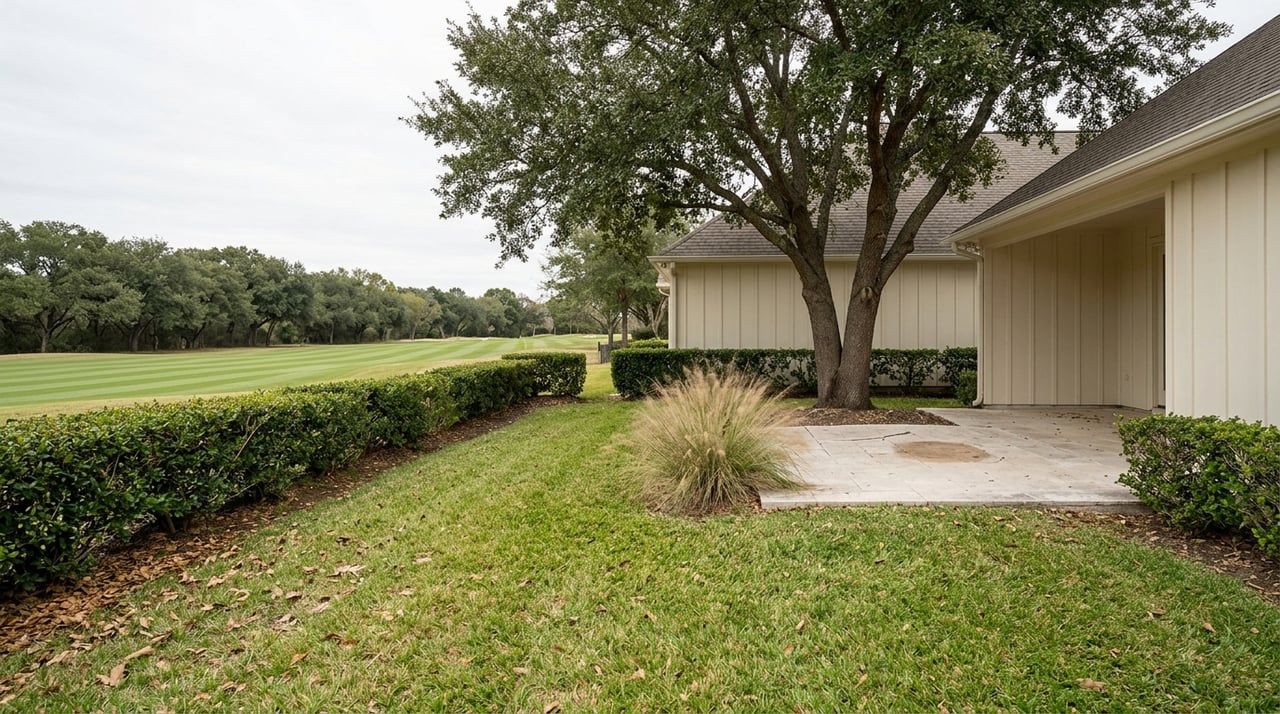
On the second Wednesday of most months, the parking lot at Blue Lake Golf Club fills up with cars that never make it to the tee box. People come carrying casserole dishes and folding chairs, not clubs. Inside, the clubhouse turns into the closest thing this stretch of Lake LBJ's southern shore has to a town hall.
That is not an accident of scheduling. Blue Lake Estates has no commercial strip, no courthouse square, no cluster of storefronts anyone would call downtown. What it has instead is nine holes of golf, a clubhouse, and a property owners' association that has run both since before most current residents moved in. If you live here, you already know the course does more than host golf. What might surprise you is how deliberately that outcome was built in, and how long it has held.
A Course the Neighborhood Actually Owns
Blue Lake Golf Club opened in 1962, designed by Joe Finger, a member of the Texas Golf Hall of Fame. For its first decade the course belonged to the development company that built the surrounding lots. Then, in 1972, the Blue Lake Estates Property Owners Association bought it outright.
The purchase price was $25,000.
That single transaction changed who the course answers to. A developer-owned course exists to sell lots and then, eventually, to be sold or leased for profit. A resident-owned course exists to serve the people who already live there and keep paying dues. Once the POA held the deed, the golf club stopped being a sales amenity and became neighborhood infrastructure, funded the same way the parks and piers are: through annual assessments the association collects from every property owner.
That ownership structure is why the clubhouse can host a potluck on a Wednesday night without anyone worrying about food and beverage minimums or event fees eating into a golf pro's bottom line. It is also why the course has stayed a modest, walkable nine holes instead of expanding into a resort-style operation chasing outside golf traffic. The Blue Lake Golf Club is open to the public and sits about three miles from the center of Horseshoe Bay, but its calendar and its clubhouse still run on the neighborhood's clock, not a hospitality company's.
What the Clubhouse Calendar Actually Looks Like
Ask a longtime resident what happens at the club and golf is only part of the answer. The Community Center, attached to the clubhouse, hosts mahjong, bridge, and other card groups, along with exercise classes, study groups, and book clubs throughout the month. There is a small library on site where residents donate and borrow books at no charge. The best-attended fixture is the monthly gathering known simply as C&C, short for Cocktails and Conversation, held the second Wednesday evening at the Community Center with residents bringing potluck dishes, desserts, and drinks to share.
None of that requires a golf handicap or even an interest in the sport. It requires proximity, and proximity is the one thing every Blue Lake property owner already has.
The course anchors the center of the peninsula, but the association maintains a ring of smaller gathering points around it, each with a distinct role:
- Driftwood Park, next to the Blue Lake Marina, with a day-boat dock and a swimming area for residents who want lake access without launching a boat.
- Blue Ridge Park, a quieter waterfront spot shaded by mature live oaks, built for sitting rather than swimming.
- Sandy Creek Park, which functions less as a gathering space and more as overflow storage for boat and utility trailers residents would rather not park in their own driveways.
- Devil's Hollow Park, where the association added retaining walls and deepened the boat launch after the lake level was lowered 31 feet in 1970, a project that still shapes how the park handles boat traffic today.
Each park does one job well. None of them tries to be the social center. That role stayed with the clubhouse.
The Marina Handles the Boats. The Clubhouse Handles Everyone Else.
Blue Lake Marina sits right next to Driftwood Park and is privately owned, offering no discount to POA members. It is a useful, necessary piece of the community's relationship with the water, but it operates as a business, not a shared amenity. Boat owners pay market rates like anyone else would at any marina on the lake.
That distinction matters more than it sounds. The one genuinely commercial node in Blue Lake Estates handles boats. Everything social, from card games to potlucks to holiday events, routes through property the neighborhood itself owns and governs. There is no coffee shop acting as an accidental living room here, no restaurant patio where everyone happens to end up. The clubhouse is the living room because the POA structured it that way more than fifty years ago and never let that function drift elsewhere.
The Fourth of July Test
If you want to see the arrangement working at full capacity, watch what happens on the Fourth of July. The day typically opens with a parade of decorated golf carts competing for prizes in categories like most patriotic, rolling through the community with the kind of low-stakes pageantry that only works in a place small enough for everyone to recognize each other's carts. Children's games and snacks follow. Lunch moves into the Community Center, where hamburgers and hot dogs give neighbors a chance to catch up.
The night belongs to the water. Beginning at dark, residents and their guests fill decks, docks, and boats to watch fireworks fill the sky over Lake LBJ. There is no municipal fireworks budget behind this and no ticketed event. It runs on the same infrastructure as everything else here: association-owned property, resident labor, and a clubhouse that has hosted the planning and the lunch for longer than most current owners have lived on the lake.
Still Running in 2026
The structure has proven durable enough to absorb growth without losing its shape. In 1998, a new section called Hilltop at Blue Lake Estates was formed and folded into the same POA, adopting more restrictive covenants of its own while remaining subject to the broader community's rules. The golf course kept functioning as the shared hub through that expansion rather than splintering into separate amenities for separate sections.
The course itself keeps earning outside recognition on its own terms. The Dallas Morning News has named it one of the Top 25 Nine-Hole Courses in Texas, a notable mark for a track that tops out at 2,376 yards and a par of 32. It is not chasing prestige through size. The club's 2026 calendar includes events like the Triple Crown Golf Tournament, held in May with a non-golfer welcome built into the invitation, a small detail that says a lot about who the event is actually for. You do not need a swing to be part of what happens there.
None of this means you need to golf to benefit from living near a course. The point is closer to the opposite. Because the neighborhood owns Blue Lake Golf Club outright, its social calendar was never left to chance or outsourced to whichever restaurant happened to open nearby. Fifty-four years after the POA wrote that $25,000 check, the arrangement is still the reason a Wednesday evening in Blue Lake Estates looks the way it does: a clubhouse parking lot fuller than the tee sheet, and neighbors who came for the conversation, not the golf.
If you are curious about what else makes this stretch of Lake LBJ's southern shore work the way it does, or you know someone weighing a move to this part of the lake, Lake LBJ Partners has spent decades learning these communities from the inside. Reach out anytime you want a straight answer about what living here actually involves.
